
2 Min Drill
Play 2 Min Drill Online Free
Start 2 Min Drill in the panel below — it runs in your browser, with no download and no install.

ready to fight
2 Min Drill
Press play to load 2 Min Drill in this page.
On a touch device, use the on-screen controls or swipe where the game supports it. Fullscreen gives you more room to play.
2 Min Drill: One Call Against Eleven
City Brawl puts you in a street where the crowd arrives from both sides. 2 Min Drill moves the same problem onto a field and hands the crowd helmets.
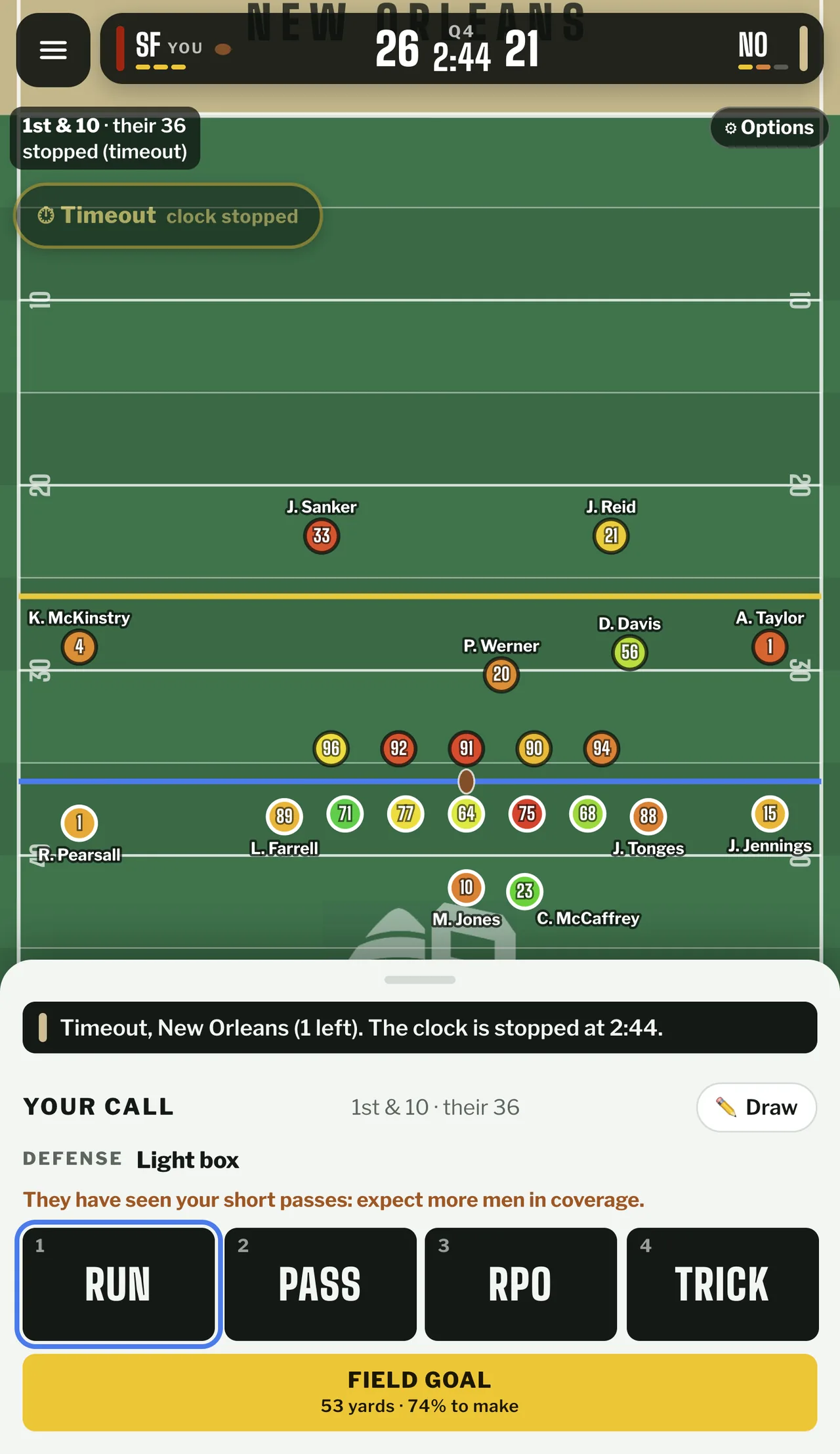
You play 2 min drill online as a coach who gets one decision at a time. The screen hands you a late-game situation with the score, the clock, the down and distance, the field position and the twenty-two players who were actually on the field. You call the play, the snap follows, and the result comes back as a shift in win chance rather than a highlight. The defense is already in position when you choose, which is the whole difficulty. Every call is a guess about eleven players who have already moved, and the game grades how much your guess changed the outcome.
2 Min Drill in Play: Read, Choose, Result
Calling a Play: Taps, Number Keys and the Snap
- 1Score, clock, down, distance and field position sit above the play board. The personnel grouping tells you who is on the field before you look at a single route.
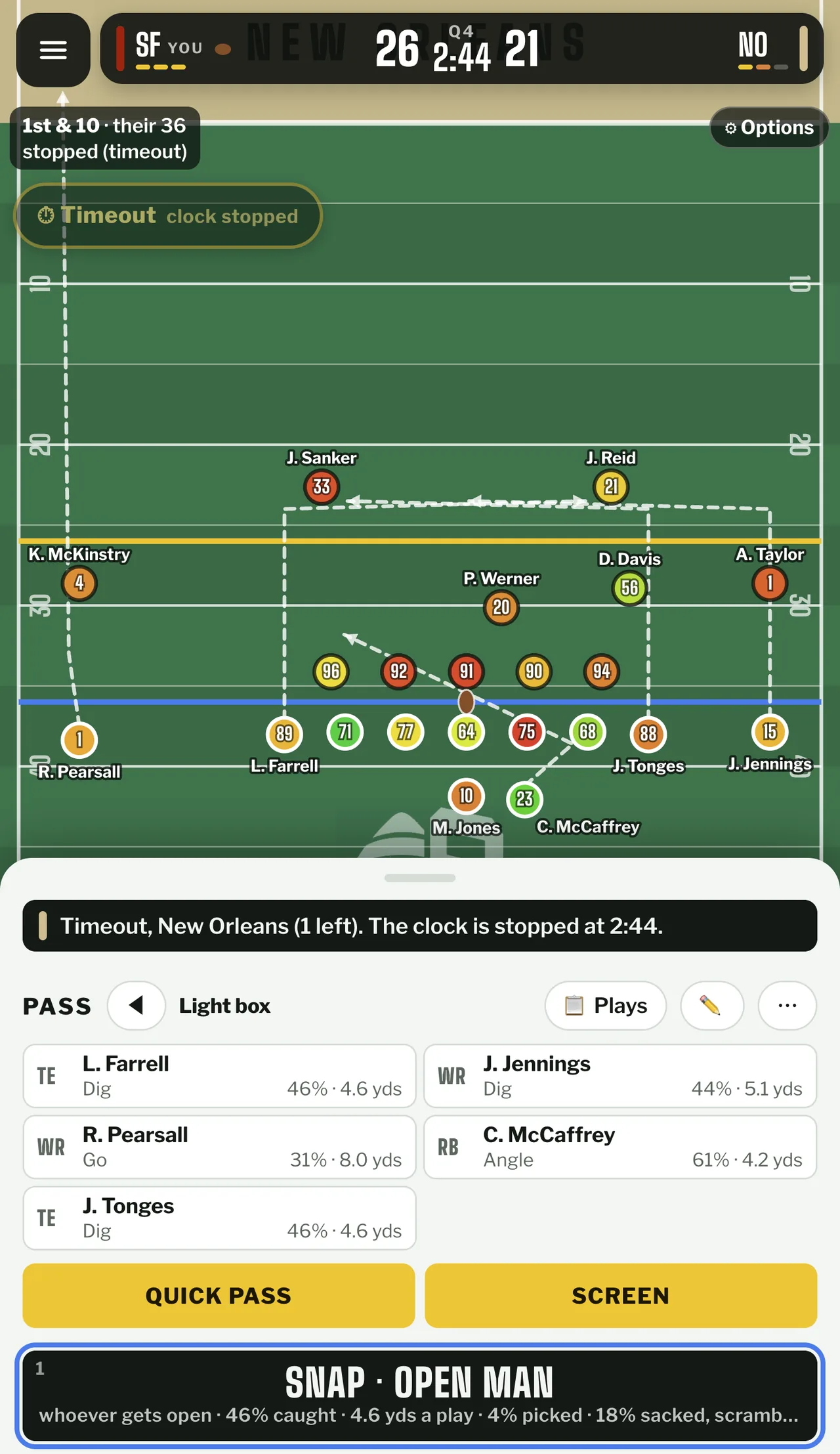
- 2The board lists numbered options. Each receiver shows a catch rate, which is a probability attached to the target rather than a promise about the throw. (Click or tap)
- 3Every numbered option is bound to its digit, so a call can be made without moving the pointer away from the field. The key map follows the numbering on screen. (1 to 9)
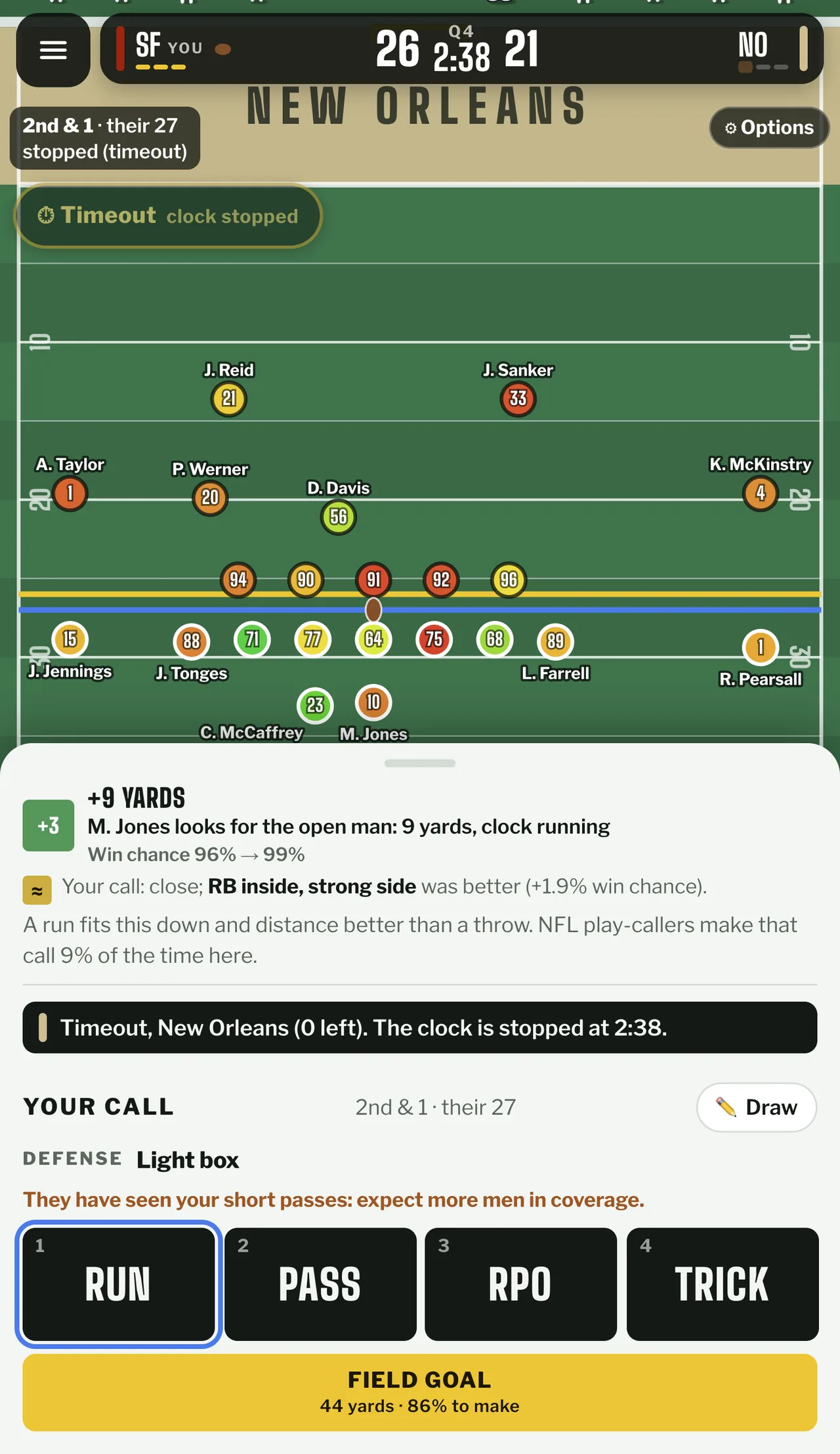
- 4Space clears the kickoff animation when it plays and returns you to the decision. The snap follows the call, and the result banner reports how far the win chance moved. (Space)
Where the Ball Goes When the Box Is Crowded
The receiver list is where the crowd reappears on a football field. A crowded box pushes a coach toward the safest completion, and the safest completion is often the throw into the crowd. The game prints a catch rate on every option, so the temptation is visible in numbers: the highest percentage frequently belongs to the short route with the most bodies near it.
Win chance is the second number, and it disagrees with the first often enough to be useful. A high-percentage throw that gains four yards can leave the win chance almost where it was, while a lower-percentage throw into space can move it a long way. Reading both, instead of the catch rate alone, is the closest thing here to a footwork drill.
When the pressure is already in the pocket, the call that survives is the one that puts the ball where the crowd is not. That is the same instinct City Brawl asks for when a group closes in: move to the side the group is leaving, not the side it is filling.
First Read or Checkdown: What a Late Call Costs
The defense moves first in the only sense that matters: it is already aligned when the situation loads. Your information is the part you control, and it sits in plain sight. Player ratings run from 40 to 99 on the twenty-two men on the field, personnel groupings are named by how many running backs and tight ends are in the huddle, and the clock decides what a first down is worth. A call that ignores the clock is a call made with half the situation unread.
Grading rewards the call that changed the outcome, not the call that looked clever. Four bands sort the result, and the rules page describes a comparison against 6,000 simulated coaches, which is a useful mirror: a decision that felt bold and graded poorly was probably a decision the situation did not support. My reading of that design is that it punishes the checkdown less than players expect and punishes the deep shot taken with no clock pressure more.
Daily, Survivor, Versus and Pro: Pick Your Pressure
Four modes split the same situation pool into different kinds of pressure. Daily gives one situation a day and a numbered run to compare. Survivor strings calls together and ends the run on a bad one, which is the closest the game comes to a wave fight. Pro adds the archive of past dailies and historical situations for a one-time payment. Versus appears in the mode list, and I found no rule page that describes how it runs.
Pick by what you want to lose. Daily costs a minute and teaches one situation. Survivor costs a run and teaches you which calls you actually trust. Anyone coming from a brawler will recognise the second one, because it is the mode where a single bad position ends the session, and no amount of good play afterwards brings it back.
Free to Start, 4.99 for the Archive
The base game costs nothing. Pro is a one-time 4.99 dollars and buys the archive rather than an advantage: past dailies and historical situations. Nothing in the free modes is gated behind it.
Buying in makes sense for a player who wants to work through old situations deliberately, the way a brawler player grinds one stage. It does not make the daily easier, and a player who opens the site once a day will get little from it. My advice is to spend a week on the free modes first and let the archive be a decision you make with a hundred situations behind you.
Real Data, Unofficial Game
The stats look real because they are. Situations are built on nflverse and FTN Data under a CC BY-SA 4.0 licence, which also requires attribution when that data is reused. Team names, player names and real game data appear throughout, and the footer states plainly that the game is unofficial and unaffiliated with the league, its teams and the players' association.
That disclosure shapes what the page can promise. The numbers carry the weight of the source data while the branding stays at arm's length, and a reader who wants an officially licensed football product will not find one here. For a free daily game the trade is a reasonable one, and it explains why the situations read like broadcast footage instead of invented plays.
The Other Build Called 2 Minute Drill
A second build circulates under the same name at 2mindrill.online. It runs a different mode set, a smaller playbook and a larger situation count, carries a preview label, and refuses to load inside another page, which is why it does not appear here. The address in your tab decides which set of numbers you are reading.
Guides and videos do not always say which build they used. A tip about the size of the situation pool or the shape of a mode can be right for one and wrong for the other, and the URL is the only reliable check. Assume nothing transfers until you have seen the same screen in the build you are playing.
Other One-Against-Many Games: Alternatives to 2 Min Drill
If the appeal is a single decision against a group already in position, three other games here run the same idea at very different speeds.


